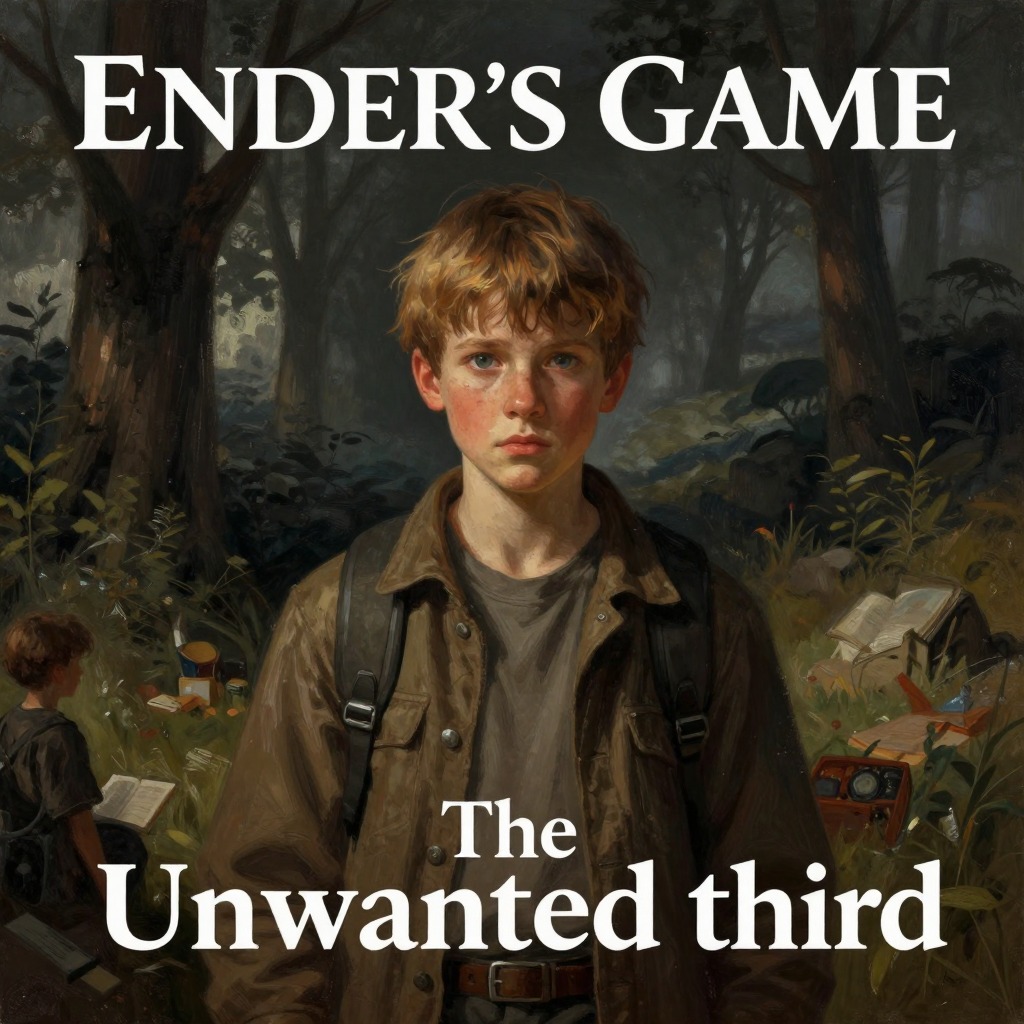
Noncomplying Families Act
The Noncomplying Families Act is a punitive international law that restricts the rights and resources of families who have more than the legally permitted number of children, creating a system of social and economic sanctions that profoundly shapes the lives of the Wiggin family and the broader society in Ender's Game. It is the legal mechanism that defines Ender Wiggin as a stigmatized "Third" and drives the central tensions of his family life, his recruitment into the International Fleet, and the political debates that follow the war.
Definition and Legal Framework
The Noncomplying Families Act is a law designed to enforce population limitation by penalizing families that exceed the legally allowed number of children. Under this regime, only the first two children in a family receive a free education, and taxes rise steadily with each additional child . The law creates a system of "compliance" and "noncompliance," where families who have more than the allotted two children are subject to international sanctions and social ostracism. The Act is so powerful that it can force individuals to renounce their religious and cultural identities to escape its penalties. Ender's father, born John Paul Wieczorek, invoked the Act at age sixteen to separate himself from his own family of nine children, changing his name, renouncing his Catholic religion, and vowing never to have more than two children . This personal history of escape and assimilation makes the Wiggins' decision to have a third child, even under government authorization, a profound betrayal of their own survival strategy.
Social and Psychological Consequences
The Act creates a rigid social hierarchy where "Thirds" are stigmatized and their families are marked by shame. Ender's parents, who both renounced their religions (his mother was a Mormon), are deeply conflicted about his existence. They see him as a badge of pride for circumventing the law, but also as a badge of cowardice for not practicing the noncompliance they still feel is right, and as a badge of public shame that interferes with their efforts at assimilation into normal complying society . This tension is a constant source of disruption in the Wiggin household, as Ender's very life is a reminder of the past his parents are trying to evade . The Act also fuels the cruelty of children like Stilson, who taunts Ender by calling him "Third" and "turd" , and it is the basis for Peter's mockery and resentment, as he sees Ender as a living proof that he himself was not good enough for the Battle School . The law's power to define a child's worth is so absolute that Ender internalizes his status, thinking, "It was not his fault he was a Third. It was the government's idea, they were the ones who authorized it" .
The Act and the Battle School
The Noncomplying Families Act is directly tied to the International Fleet's recruitment of Ender. Because he is a Third, his birth was only possible through a government waiver, and his parents signed a consent form at the time of his conception, granting the I.F. rights to him if he qualified . Colonel Graff uses the Act to manipulate Ender into leaving for Battle School, explaining that his parents' feelings are "ambiguous" because having a Third undoes everything they have been trying to do to assimilate . The Act is thus a tool of the state, used to justify the removal of a child from his family for military purposes. The law's existence also creates a class of children who are, in Graff's words, "a perpetual, self-renewing underclass, helpless to escape from the decisions of adults" .
Post-War Repeal and Legacy
After the Third Invasion, the Noncomplying Families Act is repealed as part of the colonization movement. Graff, now the Minister of Colonization, announces the repeal, stating that "all those thirds and fourths and fifths get on starships and head out for worlds known and unknown" . The Act's repeal is a direct consequence of the victory, as the need for population control is replaced by the need for colonists to populate the empty bugger worlds. Demosthenes, the pseudonym of Valentine Wiggin, publishes a scathing denunciation of the population limitation laws, arguing that "the most noble title any child can have is Third" . This political act is a direct challenge to the system that had stigmatized her brother and her family, and it marks a turning point in public opinion. The Act's legacy, however, is the deep psychological scar it leaves on Ender, who carries the burden of being an unwanted, legally anomalous child even as he becomes the savior of humanity.